
A structured, human space where conversation replaces conflict, and families build clear, workable plans — together, on their own terms.
"Mediation is not a contest. It is a structured discussion in which both parties maintain full autonomy over their choices."
When families come to hard places, words can sting, and decisions that once felt manageable can begin to feel impossible.
This is not a legal lecture. It is not a sales pitch. What you will find here is a pure description of what family mediation is, how it typically works, and how it helps people return to firmer ground — with dignity intact and practical plans in place.
If you find yourself reading this amid anxiety or tension, you are not alone. The same difficult questions confront many families. Mediation is a path that restores choice to the people who will actually live with the decisions — not decisions handed down from the outside, but arrangements built together, in good faith, at a pace that suits everyone involved.
Read slowly. Return to any section that feels relevant. The goal here is clarity, not added pressure.

The court process can feel formal, costly, and remote from the genuine requirements of family life. It is often experienced as one party against another — a process that prioritises winning over wellbeing, and precedent over the particular needs of your children and household.
Mediation is fundamentally different. It is centred on conversation rather than confrontation. When tempers rise, the mediator gently prompts a return to practical discussion. The outcome is typically faster, more personal, and far more future-focused than dwelling on past grievances ever allows.
Most importantly, mediation keeps control where it belongs — with the family. Decisions are made by the people who will live with them, not prescribed from above. That distinction matters profoundly for how families adjust, rebuild, and move forward.
Mediation is not a no-hard-feelings zone — it fully acknowledges those feelings. But it frames the discussion so that decisions can be made without the process ever devolving into a binary of winning or losing.
There is a comforting predictability to mediation. The steps are designed to bring people in gradually, keep them fully informed, and guide them toward practical, lasting agreements — at a pace everyone can manage.
The process usually begins with a brief, quiet initial conversation. These discussions are entirely private and help the mediator understand the situation — what the key concerns are, what each person is hoping for, and whether mediation is likely to be a helpful path forward. There is no obligation at this stage. It is simply a chance to ask questions and gain a clearer picture.
A dedicated meeting walks both parties through the mediation process. Everyone learns how the sessions are structured, what confidentiality means in practice, and what they can reasonably expect. This meeting is an open opportunity to ask questions, voice concerns, and determine whether mediation feels like the right fit for your particular circumstances.
Before joint sessions begin, the mediator may meet with each person separately. These individual meetings allow each party to share their priorities in a safe, pressure-free setting. They help surface the most important issues early, ensure each person feels genuinely prepared, and significantly reduce surprises when everyone comes together. Preparation makes the shared sessions more focused and productive for everyone.
These are the sessions where both parties meet together, guided by the mediator. Clear ground rules are established from the outset, ensuring the conversation remains civil and constructive throughout. Each person speaks in turn. The mediator helps clarify points raised, manage any tension that arises, and keep the discussion focused on practical, future-oriented outcomes rather than past grievances.
During sessions, time is dedicated to exploring the realistic range of possibilities available to the family. The mediator helps both parties think through different approaches, understand the implications of various arrangements, and work toward practical trade-offs that genuinely reflect what each person needs. No option is dismissed without fair consideration.
If both parties reach agreement on the key points, the mediator helps prepare a written summary. This document can be as detailed as the family requires — covering children's schedules, financial responsibilities, division of shared items, communication methods, and a clear process for revisiting the plan if circumstances change. The agreement belongs to the family.
A written agreement ensures everyone remembers what was agreed and why. It serves as a practical reference should questions arise later, and reduces the likelihood of misunderstandings developing over time. Families who wish to formalise the agreement legally may seek independent legal advice to do so. The core achievement — a fair, human plan built together — is the mediation itself.
Mediation is not reserved for any single type of family situation. It is a flexible process — one that adapts to where families are, not where they are expected to be. That flexibility is one of its most valuable qualities.
Families come to mediation from many different starting points. Some have managed to remain broadly civil but find themselves stuck on specific practical questions. Others have experienced significant breakdowns in communication and feel unsure how to re-establish a working relationship. Some are in the early stages of separation, others are revisiting arrangements that have stopped working.
What all of these situations share is the potential to benefit from a structured, guided conversation — one held in a safe environment, with a neutral third party keeping the dialogue focused on practical, constructive outcomes.
Mediation tends to be most effective when both parties are willing to participate in good faith, even if they arrive with very different perspectives or feelings about the situation. It does not require agreement on everything before it begins. It only asks for a willingness to engage.
Families navigating separation, where practical questions about living arrangements, children, and finances need to be worked through thoughtfully and without escalation.
Parents who are no longer together but committed to raising their children well, who need structured support for designing shared parenting arrangements.
Families where patterns of miscommunication or ongoing conflict have made it difficult to have productive conversations, even when both parties care deeply about reaching good outcomes.
Situations involving step-parenting, grandparent roles, or other family members where relationships are complex and clear, respectful communication is especially important.
Each family situation is unique. Mediation is flexible enough to meet families wherever they are, and structured enough to keep every conversation useful and on course.
When a relationship is ending, a multitude of practical questions arise all at once: where will the children live, how will time be shared, how will daily routines be preserved? Mediation encourages families to work through each question with a clear focus on stability rather than allowing emotion alone to drive decisions. It is not about erasing feelings — it is about giving them a constructive channel.
Parents worry about children first, and mediation reflects that priority. The process is focused on what children genuinely need: routine, constancy, and emotional safety. It assists in designing practical parenting plans that work with the demands of everyday life — school runs, childcare, holidays, and each child's individual temperament and relationships. Plans are built around your children, not around administrative convenience.
Talking about money during a period of family change is rarely straightforward. It carries weight far beyond the numbers themselves. Mediation offers a calm, structured way to examine shared assets, discuss budgets, and clarify respective financial responsibilities going forward. The aim is equitable, sustainable settlements — not forcing either party to extremes, but finding arrangements both can genuinely live with.
Sometimes the problem is not one particular issue but an entrenched pattern — a cycle of miscommunication where every conversation seems to return to the same impasse. Mediation can interrupt that cycle. The mediator actively promotes clearer, more constructive ways of speaking. Over time, the new habits built during mediation reduce both the frequency and the severity of ongoing conflict in everyday life.
Families are complex, and the relationships within them do not exist in isolation. Questions around step-parenting, grandparent involvement, and wider family dynamics can all affect the wellbeing of the immediate family unit. Mediation creates space for these conversations to happen thoughtfully, ensuring that the needs of the core family — and particularly the children — remain at the centre throughout.
Life changes — children grow, circumstances shift, and arrangements that worked well at one stage may need revisiting. Mediation is equally valuable for families returning to reconsider earlier plans. A structured conversation supported by a mediator allows for changes to be made collaboratively, without either party feeling that a hard-won agreement is being challenged unfairly or unilaterally.
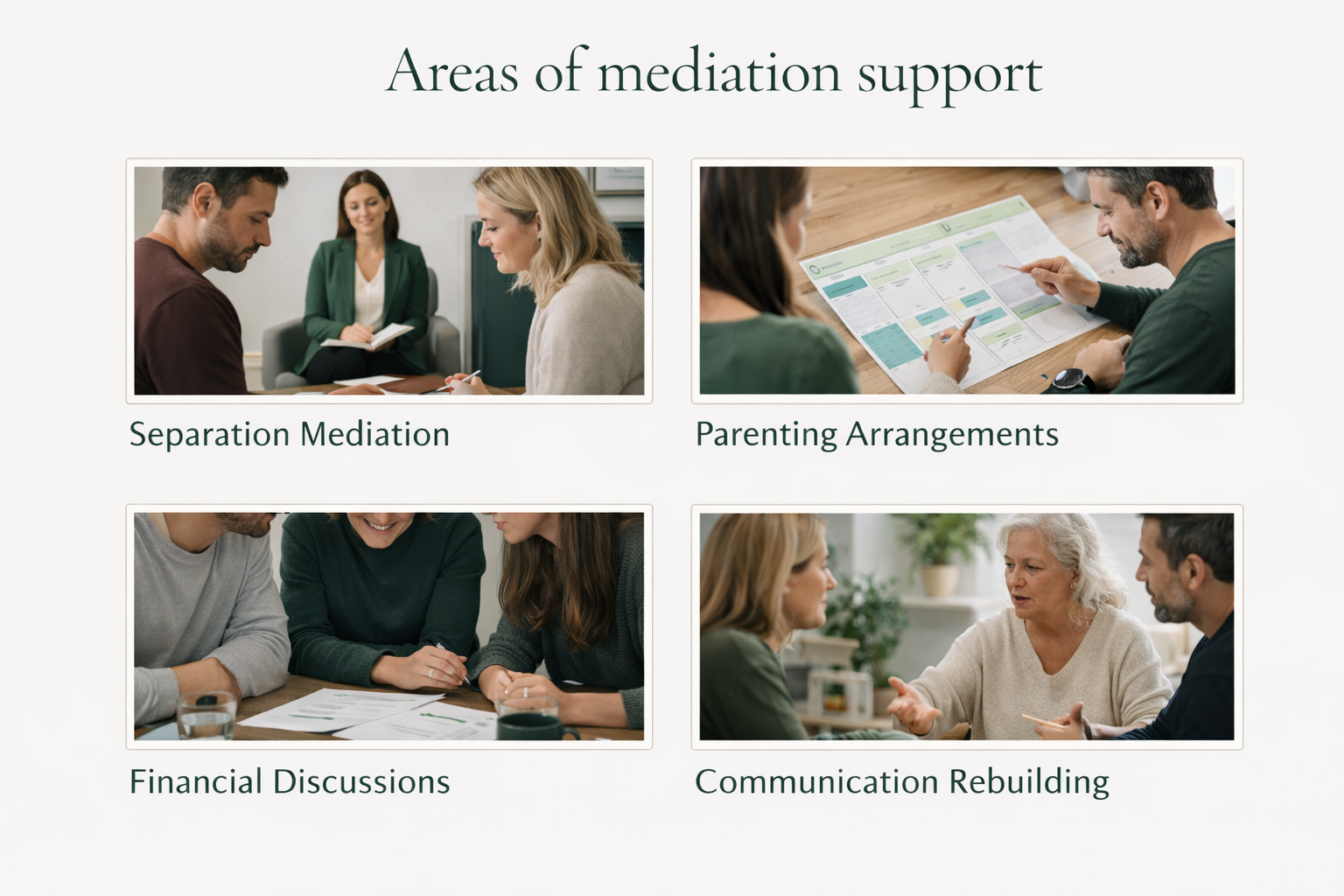
Mediation is available across a range of distinct but overlapping areas of family life. Each area shares the same underlying approach: keep the conversation human, practical, and consistently focused on solutions that work with real family life — not against it.
In every area, the mediator remains impartial. Their focus is not on deciding who is right or wrong, but on ensuring that both parties have a genuine opportunity to speak, to be understood, and to move toward arrangements they can each live with. The mediator does not provide legal advice during sessions, but can describe how processes typically work and what families generally take into account when making these decisions.
If legal or financial expertise is required beyond what mediation can offer, mediators can refer families toward appropriate professional advice — without this in any way replacing or disrupting the mediation process itself.
Focused on the full range of practical decisions that separation requires: living arrangements, parenting schedules, financial responsibilities, and how day-to-day life will be managed. The goal is to move from uncertainty to a clear, workable plan.
Centred entirely on children's routines and wellbeing. Parents work through who is responsible for school runs and childcare on which days, how holidays will be divided, how contact with extended family will be managed, and how to maintain as much predictability and security for children as possible.
Covering the division of shared assets and responsibilities, understanding each party's financial situation clearly, and working toward fair outcomes that neither party will struggle to sustain long-term. Candour is encouraged in a supportive environment.
Where conflict has become entrenched, mediation introduces practical tools for better communication. The mediator helps both parties practise listening carefully, managing strong emotions constructively, and keeping conversations focused on what actually needs to be decided.
Addressing conversations that involve grandparents, step-family members, or other significant relationships — held in a way that keeps the immediate family's needs central while treating all relationships fairly and with appropriate respect.
Mediation is practical and unglamorous. It does not relieve suffering or loss. But it does make the chapter that follows loss significantly less frantic and considerably more manageable.
Mediation is generally faster than court-based processes. However, the pace is set by the family — not by external deadlines or administrative pressures. Sessions unfold at a speed everyone can manage, with time between them to reflect, gather documents, or consult trusted friends and advisers.
Progress in mediation is rarely entirely smooth. Some sessions will feel more productive than others. Strong emotions may surface. There may be moments of stalemate. The mediator is experienced in managing these moments — not by suppressing them, but by finding a path through them that keeps the process moving constructively.
Mediated agreements are not legally binding in themselves. They are, however, the product of genuine mutual discussion — and people who build their own arrangements tend to find them far easier to live with than those imposed externally. Many families choose to formalise the agreement legally afterwards if they wish to do so.
Mediation works well for many families, but not for every situation. If sessions do not produce full agreement, the mediator will discuss other options openly and without judgement. Even partial progress — or simply gaining a clearer understanding of where the genuine disagreements lie — can be genuinely valuable when considering what steps to take next.
"Being heard reduces anger. When both parties feel genuinely listened to, finding workable compromises becomes considerably more possible — and the small details that matter most to each person can finally be properly attended to."

Mediation operates within clear professional and ethical standards. Confidentiality is fundamental to the entire process. What is discussed during mediation is generally not usable in court proceedings. This protection is explained clearly by the mediator right at the outset — before any substantive discussion begins — so that everyone can speak openly without fear of repercussion.
There are some limited exceptions to confidentiality — primarily in relation to safety concerns or serious criminal matters — and these are explained transparently so that everyone enters the process fully informed. The principles of confidentiality, impartiality, and informed consent underpin every aspect of professional mediation practice.
The mediator remains strictly impartial throughout all sessions. Their role is not to advocate for either party, not to make decisions on anyone's behalf, and not to judge the choices that families have made. Their job is to facilitate productive, fair conversation — and to help both parties move toward workable arrangements in a structured, supported environment.
When children are part of the picture, their wellbeing comes first. Mediation is particularly well-suited to families with children because it gives parents the ability to design arrangements that genuinely reflect each child's needs, routines, and relationships.
Mediation helps parents design parenting plans that establish the predictable routines children depend on for their sense of stability and security. School arrangements, activity schedules, holiday plans, and special days are all worked through carefully — building a structure that feels familiar and safe to children even as family arrangements change around them.
Children do best when adults around them are cooperating calmly and when their daily lives feel predictable. Mediation actively protects children's emotional safety by focusing on planning, stability, and civil adult communication. By reducing ongoing parental conflict, it shields children from the kind of ongoing instability that causes the most lasting harm.
Wherever it is safe and appropriate, children benefit enormously from maintaining close, loving relationships with both parents. Mediation works to design arrangements that honour these relationships in practical, day-to-day terms — rather than reducing them to abstract schedules or adversarial timetables. It places the child's genuine experience at the centre of every conversation.
One of the most delicate parts of family change is helping children understand what is happening in ways that are age-appropriate, honest, and reassuring. Mediation creates space for parents to discuss together how to communicate changes to their children sensitively — ensuring that children feel informed and supported, rather than confused or caught between competing adult narratives.
Many families report that the effects of mediation extend far beyond the specific decisions made during the sessions. The agreements reached and the communication habits practised tend to shape family life in quieter, steadier ways for years afterwards.
A clear, well-structured written agreement reduces ambiguity in daily life. Small disputes are less likely to escalate when expectations have been clearly spelled out and mutually understood. The sense of shared responsibility that mediation builds reduces the emotional load on everyone in the household — not just in the weeks immediately following the process, but month by month, as life continues to change and require adjustment.
Families who can adapt to change with less conflict often move forward into genuinely new and healthier patterns. Children who observe their parents communicating constructively — even amid difficulty — carry those lessons with them. The work done in mediation, though practical and unsexy, has a quiet importance that families frequently only appreciate in hindsight.
Arrangements that people build themselves are significantly less likely to be difficult to live with over time. They work organically with the family's daily reality, rather than sitting awkwardly against it. This dramatically reduces the likelihood of needing to return to formal processes later.
When expectations are clearly defined and mutually understood, the day-to-day frictions that push families back into conflict simply have far less room to develop. A clear plan provides a shared reference point — something both parties can return to without needing to relitigate the same ground repeatedly.
Mediation builds communication patterns that support long-term collaboration. Many parents report that they have learned to make small day-to-day decisions jointly without significant conflict — not because the original disagreements vanished, but because the tools for managing them have genuinely improved.
Children thrive when adult life is predictable and the adults around them are cooperating. Because mediation focuses consistently on planning and stability, it tends to meaningfully protect children from the instability that causes the most developmental and emotional harm — both in the short term and long into the future.

Mediation is not only about making new decisions. It is also about learning to communicate in ways that make daily family life calmer, more constructive, and more sustainable over time.
The communication practices introduced during mediation are not sophisticated or complicated. They are practical tools that, with regular use, become natural habits. The mediator creates a safe environment in which to practise them — gently intervening when the tone drifts, and returning the conversation to a place where both parties can hear each other clearly.
Short, clear statements. Talking in short, simple sentences focused on what is needed right now, rather than sweeping generalisations or long-accumulated grievances.
"I" statements. Describing feelings and needs from your own perspective — "I find it difficult when..." rather than "You always..." — reduces defensiveness and keeps the conversation moving forward.
Active listening. Before responding, reflecting back what you have heard to confirm accurate understanding — a small habit that prevents an enormous number of misunderstandings from developing.
Staying on topic. Keeping discussions focused on the specific matter at hand, rather than allowing older resentments and unrelated grievances to enter conversations where they cannot be usefully addressed.
Agreed processes for raising concerns. Developing a simple, mutually understood way to raise issues later as they arise — without those concerns needing to escalate into arguments before they can be heard.
Emotional regulation. Learning to pause, breathe, and return to a place of practical focus when strong emotions arise — so that difficult conversations can continue productively rather than shutting down entirely.
These are questions that people frequently carry when they first begin to think about mediation. They are answered here directly and honestly — because clarity at the outset makes everything that follows simpler.
If you have questions that are not covered here, a brief, entirely private initial conversation can often provide the clarity needed to decide whether mediation is likely to be helpful for your particular circumstances.
Family mediation is a professionally assisted dialogue. A neutral, trained third party guides each person to discuss their concerns openly and work toward concrete, practical plans together. The goal is to develop solutions that actually work in real family life — especially, and always most importantly, for any children involved. It is entirely different from a court process: it is a conversation, not a contest.
Yes. Confidentiality is a cornerstone of mediation and is what makes open, honest discussion genuinely possible. What takes place during mediation is generally not usable in court proceedings. There are limited exceptions — primarily relating to safety concerns or serious criminal matters — and these are explained clearly by the mediator right at the start of the process, before any substantive discussion begins.
For joint sessions, yes — mediation only works if both parties participate. However, mediators typically begin by meeting with each person separately, in individual preparatory sessions. These individual meetings can be arranged independently and do not require the other party to attend. They help the mediator understand each person's situation and priorities before joint discussion begins.
Mediation is particularly well-suited to parenting matters, because the entire process keeps children's day-to-day needs at the centre of every discussion. Parents work together to create schedules and arrangements that genuinely reflect each child's routine, relationships, school life, and activities — rather than abstract timetables that look neat on paper but create practical difficulties in daily life.
Not automatically. Mediation produces a written summary of what has been agreed, which both parties can then use as the basis for a legally binding document if they choose to formalise it. Many families find that the mediated agreement itself — built on mutual understanding and shared ownership — is the most important outcome, and they seek formal legal validation only if and when they feel it is necessary.
Mediation is not the right path for every situation, and the mediator will be honest about this if it becomes apparent. If sessions do not produce full agreement, the mediator will discuss other available options openly and without judgement. Even where full agreement isn't reached, the process of mediation often clarifies where the genuine disagreements lie — which itself can be an important and constructive step when considering what comes next.
Absolutely not. Most people begin mediation with just a handful of questions and a hope that conversations might become calmer and more constructive. The mediation process is designed to work with you — to help clarify what matters most, surface the options available, and build toward agreements gradually. You do not need to arrive with all the answers. You only need to arrive willing to explore.

These reflections represent the kinds of experiences families describe after working through mediation. They are offered here not as proof of guaranteed outcomes, but as honest illustrations of what the process can mean in practice.
I came in expecting it to be confrontational and exhausting. What I found instead was that having someone else in the room — someone completely neutral — meant we could actually hear each other in a way we hadn't managed to do on our own for a very long time. We didn't agree on everything. But we agreed on enough to move forward, and that was more than I had hoped for.
The thing that helped most was that the sessions were focused on the children — not on who had done what wrong in the past. We walked out with a plan that actually made sense for our son's week. His school life stayed stable. That mattered more to us than anything else.
I had no idea how much I needed someone to ask the right questions. Left to ourselves, every conversation went in circles. In mediation, we were being genuinely guided — not pushed toward an answer, but helped to find our own. It was a very different experience to what I had expected.
Every aspect of how mediation is conducted here is shaped by the same core conviction: that families deserve a process that treats them with genuine respect, attends carefully to their particular circumstances, and helps them find their own way forward — on their own terms, at their own pace.
The mediator is neutral — but not detached. The process is warm, attentive, and genuinely human. Impartiality means that neither party is favoured; it does not mean that the mediator is indifferent to the difficulty of what families are experiencing.
Sessions move at the pace that the family can manage — not at the pace of an administrative process indifferent to human readiness. Time is allowed between sessions to reflect, gather documents, consult advisers, and return ready to continue. Nothing is rushed.
The aim is not a theoretically perfect outcome, but a practical one — arrangements that families can actually sustain in the reality of daily life. Simple, clear, workable plans that reduce ambiguity and give everyone, especially children, a stable framework to live within.
Everything about the process — how sessions work, what confidentiality means, what can and cannot be expected — is explained clearly before substantive discussion begins. Families enter mediation informed, not uncertain. That clarity is part of the professional commitment.
In every session that involves families with children, the children's wellbeing is the constant that guides the conversation. Parenting arrangements are designed around each child's actual daily needs — school life, relationships, temperament, routines — not around adult convenience alone.
Mediation is not the right path for every situation. Where it is not appropriate, that will be communicated clearly and honestly. Alternative options will be discussed. Families will never be encouraged to continue with a process that is not serving them well.
If you are considering mediation, the most important thing to know is that you do not need to have everything resolved before you begin. The mediation process is specifically designed to work with what you already have — including the uncertainty, the incomplete thoughts, and the questions you are not yet sure how to articulate.
Most people begin with nothing more than a handful of pressing concerns and a hope that things might become calmer and clearer. That is enough. The process exists to work with you — at your own pace, in your own time — and to help both parties move toward arrangements you can each genuinely live with.
If you are ready to take a first step, that step is simply a quiet, confidential conversation. Nothing is decided in an initial conversation. It is only a chance to ask questions, hear what the process involves, and assess whether it feels like the right path for your family's particular situation.
These are not rules — they are simply signs that people often find useful when considering whether mediation might be right for them.
If any of these resonate with you, mediation may be worth exploring. It is a practical approach to transforming difficult conversations into clear, actionable plans.

Life changes. Families change too. Sometimes those changes arrive quietly, and sometimes they come amid moments that feel entirely uncertain or overwhelming. When something shifts within a family, the most important things often turn out to be the everyday details — routines, clarity, fairness, and the quiet reassurance that life can continue in a steady, manageable way.
Mediation is simply a method to help those practical pieces fall into place again. It provides a space of tranquillity within which conversations can unfold with care — with the genuine hope of transforming difficult questions into lucid, practical strategies that the family themselves have shaped and agreed upon.
Family situations are rarely straightforward. The natural instinct is to take time to think things through, and there is nothing wrong with that. Mediation acknowledges that you may be balancing intense emotions, deep concerns about your children, and real fears about what the future might bring. It does not ask you to put those feelings aside. It asks only that you bring them into a conversation that is guided, structured, and genuinely focused on what comes next.
There is no pressure here to make any decision. When the moment feels right — and it will, in its own time — a gentle, confidential initial conversation is always the first and only step. That conversation exists simply to help you understand whether this particular path might assist your family in finding more stable ground.
Take a moment to pause, reflect, and gather your thoughts. That quiet act of stopping is often the first genuinely helpful step of all.